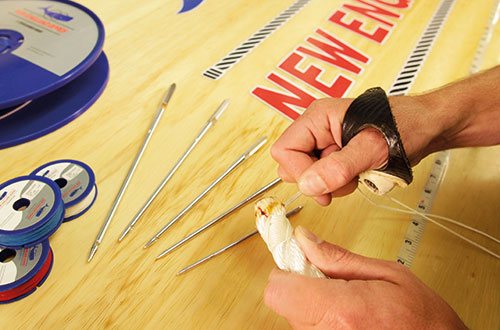
Unlay the end of each rope a minimum of 30 turns for manila, 6 to 10 turns more for nylon. Lash securely with twine as shown to prevent ropes from coming apart further. Place ropes together, alternating the strands from each. Note how strands are numbered to show their relative positions throughout the long splice procedure.
Take lashing off one side. Unlay one strand (2) a minimum of 25 turns and replace it with a strand from the other side (5) as it is being unlaid. Lash securely as shown to hold strands in place. Be sure to place lashing at the "marriage point" to hold strands securely.
Step 3 is like step 2, except in the opposite direction. One strand (6) is replaced with another (3). Each point is securely lashed. This leaves strands 1 and 4 at the "marriage point."
Remove lashings and tie each pair of opposing strands (2/5, 6/3,1/4) with an overhand knot. Be sure knot is tied in the direction of strand twist.
Tuck each strand 4 times for synthetic fiber ropes, or 3 times for manila. These tucks should be at right angles to the direction of the twist in the rope.
The splice may be tapered by adding an additional 2/3-and 1/3-strandtuck at each strand junction. Now roll and pound well. Finally cut the strands off close to the rope.